
 Tiếng Việt
 Cloud server services
 Business Email
 Content Delivery Network
 Cloud PC
 Linux Security and Hardening
In the context of a global economy being vigorously restructured on data-driven and connected foundations, Vietnam has defined Digital Transformation (DX) not merely as a technology trend but as a vital economic imperative. The macro objectives set by the Government in the “National Digital Transformation Program to 2025, with Orientation to 2030” are highly ambitious, with expectations that the digital economy will contribute 20% of GDP by 2025 and 30% by 2030. [1] However, between macro-level aspirations and micro-level implementation realities within enterprises—especially the Small and Medium-sized Enterprises (SMEs) that account for 98% of all companies—there exists a substantial execution “gap.”
This research report argues that this gap does not primarily arise from a shortage of technology or capital, but stems from deep-seated barriers in Leadership Mindset and Perception. The three principal pillars of these barriers include:
(1) A prejudiced mindset that frames technology as a “cost” rather than a “strategic investment”;
(2) A culturally rooted fear of change and of process transparency;
and (3) Misaligned expectations about the time to achieve ROI, leading to a “short-lived enthusiasm” mentality and the phenomenon of “digital relapse.”
Through aggregated data analysis, large-scale surveys, and emblematic case studies such as Rạng Đông, PNJ, and Viettel, the report provides a panoramic, multi-dimensional, and detailed picture of managerial psychology in Vietnam. Simultaneously, the report proposes theoretical frameworks and practical solutions to untie the “mindset bottlenecks,” helping Vietnamese businesses not only “buy” technology but also “live” with technology.
Part 1: Macroeconomic Context and Transformation Pressures
1.1 Policy Mandates and Market Forces
Vietnam is facing a historic opportunity to break free from the middle-income trap through the digital economy. Government commitment is clearly demonstrated via Decision No. 749/QĐ-TTg approving the “National Digital Transformation Program,” which establishes three pillars: Digital Government, Digital Economy, and Digital Society. [1] Transformation pressures come not only top-down through enabling policies but also bottom-up via shifts in consumer behavior. With the rise of a tech-savvy middle class and the boom in e-commerce, online travel, and digital media (contributing USD 29 billion in revenue), customers increasingly demand seamless, personalized, and instant experiences. [1] Businesses have no choice but to digitize to survive.
However, the readiness of the business community does not yet match this pace. Studies indicate that, prior to the COVID-19 pandemic, only about 30% of Vietnamese enterprises had truly embarked on their digital transformation journey. [2] The majority remained observers or applied technology in fragmented, piecemeal ways. COVID-19 acted as a forced adoption shock, causing the adoption rate to spike in a short time. But this rapid growth exposed critical strategic gaps, leading to technology being applied as a stopgap solution rather than a long-term foundation.
1.2 The “Digital Relapse” Phenomenon
One of the most alarming findings from research data is the rate at which technology is abandoned after deployment. According to the USAID LinkSME (2022) report, up to 48.8% of the 1,000 surveyed enterprises had experimented with digital transformation solutions but subsequently stopped using them. [2] This nearly 50% figure reflects a massive waste of resources and a failure to sustain innovation momentum.
The cause of this “digital relapse” lies not in technology quality, but in the lack of strategic alignment and long-term commitment. [2] When external pressures (such as social distancing) fade, businesses tend to revert to traditional operating habits (business as usual), viewing purchased digital tools as unnecessary burdens. This proves that, without a fundamental mindset shift, all technology investments are just “new bottles for old wine,” and enterprises will quickly discard modern tools to return to the comfort of outdated manual processes.
Part 2: Decoding Mindset Barriers — Cost or Investment?
This is considered the largest and most common barrier, especially among Vietnamese SMEs, where limited capital and persistent cash-flow pressure weigh heavily on business owners. The basic confusion between the concepts of “Expense” (money gone) and “Investment” (money that generates future returns) has constrained the growth of thousands of enterprises.
2.1 Short-Term Accounting Mindset and Loss Aversion
In the traditional management mindset of many Vietnamese business owners, information technology (IT) is often classified under general and administrative (G&A) expenses, similar to electricity, water, office supplies, or rent. When revenue declines or the economy is challenging, this is the first category to be cut. According to statistics from the Agency for Enterprise Development, 60% of businesses worry about technology investment costs, viewing them as a budget burden rather than a growth lever. [3]
This mindset stems from “loss aversion” in behavioral economics. Owners immediately see the hundreds of millions or billions of VND required to purchase ERP or CRM software or hire consultants, but they do not immediately see the benefits. IDC forecasts that global digital transformation costs are substantial, and 80% of businesses fail or delay because they deem the costs too high. [3] However, such failure is often not due to high tech costs per se, but because businesses lack the capability to quantify value from DX. They fail to calculate the opportunity cost of not transforming—losing customers to competitors, errors from manual data entry, or the cost of slow decision-making.
2.2 Insufficient Cash-Flow Strategy for Technology
Another intractable issue is that the financial structures of Vietnamese SMEs are often ill-prepared for long-term investments in intangible assets. Unlike purchasing machinery or building factories (tangible assets that can be collateralized), investments in software and data are typically harder to finance through bank loans. This forces businesses to use internal capital, intensifying pressure on operating cash flow.
When DX is treated as a cost, businesses tend to bargain-shop—choosing the cheapest solution and cutting critical components such as workforce training, process redesign, and hiring expert consultants. [3] The consequence is buying a “software shell” without the operational “soul,” leading to implementation failure and further reinforcing the false belief that “technology investment is money down the drain.” Consultants have pointed out that software licenses should account for only a small portion of the total transformation budget; the larger share must be dedicated to people and process change—intangibles that ultimately determine success or failure. [3]
Part 3: Fear of Change and Cultural Resistance
The second barrier, more subtle yet harder to overcome, is cultural and psychological. Vietnamese enterprises are deeply influenced by East Asian values that prioritize stability, hierarchy, and personal relationships. Digital transformation—by nature transparent, flattening, and data-driven—often runs counter to these traditional values.
3.1 Comfort Zone Syndrome and Legacy Processes
“The reluctance to disrupt long-established, ‘stable’ processes” is a common mindset recorded across many reports. Businesses—particularly family-owned firms or long-standing manufacturers—often operate based on processes set decades ago. [4] While manual and inefficient, these processes provide leaders with a sense of safety and control.
Process changes introduced by digital adoption are not merely about switching tools (from paper to computer), but about altering collaboration methods, reporting structures, and power distribution. This creates resistance from both sides:
Leadership: Fear of losing direct control. In the old model, power concentrates with the information holder. In the digital model, information is shared and decentralized, challenging the leader’s role as the “final arbiter.”
Employees: Fear of inadequate capability to use new technology (digital skills gap) and fear of being replaced by technology. Without effective internal communication to explain the “big picture,” employees will perceive DX as a direct threat to their livelihood, leading to covert resistance or non-cooperation. [3]
3.2 The Fear of Transparency
A distinctive characteristic of Vietnam’s business environment is the presence of “grey zones” in management. Many SMEs maintain informal accounting systems or decision processes based on intuition and personal relationships to retain flexibility. Digital transformation—with audit trails and real-time data transparency—becomes an “opponent” of this management mindset.
Internal transparency: When performance metrics, inventory, and sales figures appear clearly on dashboards, there is no room for fraud, idleness, or error concealment. This creates psychological pressure for personnel accustomed to low-control environments.
External transparency: Businesses also worry about data security and legal risks when business data is moved to digital environments (e.g., Cloud) or connected to government systems (Tax, Customs). [5] Fears of exposing trade secrets or cyberattacks make them hesitant to share data or integrate deeply into global digital supply chains. The Chairman of the Vietnam Internet Association has warned that without building digital trust, digital economy targets will remain elusive. [5]
3.3 Old-School Leadership Mindset (HiPPO)
In many Vietnamese enterprises, decisions are often made based on the Highest Paid Person’s Opinion (HiPPO) rather than data. Digital transformation requires a shift toward a data-driven culture. The conflict between the intuitive experience of the older leadership generation (often founders) and the cold analytics produced by new technology systems creates acute internal tensions. If leaders do not lower their egos to listen to data, even the most advanced technology systems are reduced to decoration.
Part 4: Misaligned ROI Expectations and Short-Term Traps
The third mindset barrier relates to patience and vision. Digital transformation is a marathon, but many Vietnamese businesses approach it like a sprint, expecting immediate results.
4.1 The Illusion of Instant Results (Instant Gratification)
Financial pressure and a “fast-result” business mindset cause owners to expect that immediately after software go-live, revenue will surge or costs will drop the following month. When reality does not align—indeed, performance may decline initially as employees learn the new system (the J-curve effect of change)—they quickly become disappointed and lose confidence.
Data shows that 48.8% of businesses stop using digital solutions because they deem them “unsuitable” or “unnecessary” once short-term pressures fade. [2] This is a clear symptom of lacking long-term vision. Businesses fail to understand that DX requires time to accumulate data, optimize models, and change user habits before delivering breakthrough value. Evaluating technology ROI using short-term metrics from traditional business is a methodological error, leading to premature and misguided investment cuts.
4.2 Inadequate Data Exploitation Capability to Generate ROI
A paradox is that businesses expect ROI but do not know how to create it from technology. Buying software without changing operating processes cannot produce new outcomes. According to Cisco & IDC (2020), data management and analytics capability are major weaknesses of Vietnamese enterprises. [6] Businesses collect lots of data from software but lack the personnel or mindset to analyze it and extract optimization points, market trends, or customer behavior.
When data remains lifeless numbers on a hard drive, rather than being transformed into actionable insights, technology truly becomes a cost. A deficiency in digital literacy among middle management and leadership prevents them from defining the right problems for technology to solve—thereby failing to realize investment benefits.
Part 5: Practical Lessons — Successes and Failures
To substantiate arguments about mindset, analyzing real-world cases is essential. Successful businesses are those that overcome mindset barriers, while failures often stem from losing the internal battle.
5.1 Rạng Đông: Rebirth Through a Breakthrough Mindset
Rạng Đông (Vietnam Electric Light Bulb Joint Stock Company) is a textbook example of shifting from a traditional manufacturing firm to a high-tech enterprise.
- Context: Facing fierce competition from low-cost Chinese goods and a 2019 factory fire causing VND 36 billion in losses, Rạng Đông faced crisis risk. [7]
- Mindset Shift: Leadership chose offense through technology rather than defensive retrenchment. They identified DX as the only pathway to rebirth. Instead of only buying machinery, they established a Digital Technology Research Center and pivoted to a Digital Business Model (DBM) that blends physical products with digital services (IoT).
- Results: Thanks to long-term thinking and willingness to dismantle legacy processes, Rạng Đông achieved 15–20% annual growth during 2020–2022, surpassing the previous 8–10% range. In 2023, revenue exceeded VND 8,300 billion. [7] The lesson: technology creates impact only when coupled with bold business model restructuring.
- 5.2 PNJ: Customer-Centric Mindset
PNJ (Phu Nhuan Jewelry) proved that even in traditional luxury retail, a digital mindset can make a difference.
- Challenge: COVID-19 paralyzed physical stores, alongside gold price volatility and supply-chain disruptions.
- Mindset Shift: PNJ moved from “counter sales” to omnichannel experiences. They invested in AI cameras to analyze in-store customer behavior (beyond security—toward customer understanding) and deployed ERP/CRM to optimize inventory. [7] More importantly, they adapted internal culture to enable rapid response.
- Results: Sales efficiency increased 200%, operating costs decreased, and brand value rose 44%. [7] PNJ succeeded because they treated DX not as an IT project but as a customer insight project enabled by digital tools.
5.3 Viettel Solutions: Changing the Work Culture
Even as a technology group, Viettel Solutions encountered rigid process barriers.
- Mindset Shift: They recognized the traditional Waterfall project model was too slow and shifted to Agile thinking with a five-step methodology: Awareness – Go Through – Implement – Learn – Enable. [7]
- Results: 17% cost savings and 30 days shaved off project timelines. The lesson: management mindset change—from control to empowerment and agility—is key to technology effectiveness.
5.4 Common Failure Root Causes
In contrast to the above, 80% of businesses that fail at DX typically fall into previously analyzed mindset traps:
- Lack of leadership commitment: Leaders issue directives verbally but do not personally engage—outsourcing to IT. [8]
- FOMO-driven adoption: Buying technology because competitors have it, without clear use cases—leading to waste. [2]
- Fear of failure: A culture that does not accept “fail fast, fail cheap” prevents experimentation.
Part 6: Solution Frameworks and Change Recommendations
To overcome mindset and perception barriers, Vietnamese businesses need a disciplined roadmap to “detox” old habits and build new capabilities. There is no silver bullet, but there are core principles to follow.
6.1 Reframing the Investment Thesis
Businesses should shift their financial approach to DX:
- Move from CAPEX to OPEX: Instead of large lump-sum infrastructure investments (high risk), leverage subscription models (SaaS – Software as a Service). This converts fixed investment into variable operating expense, reduces cash-flow pressure, and enables low-cost experimentation. [3]
- Quantify intangible value: Leaders must calculate ROI using non‑financial KPIs such as order cycle time, customer satisfaction (CSAT), and employee retention. These are leading indicators of future financial returns.
6.2 Mindset Education and Digital Culture
Mindset change must start with education. Technology can be purchased; mindset must be cultivated.
- Leadership training: Programs like SMEdx (Ministry of Information and Communications) and USAID LinkSME strategic courses are valuable resources for leaders to update their thinking. [10] Leaders must understand they are the Chief Architects of the digital system, not just software purchasers.
- Internal buy-in: Enterprises should communicate DX goals transparently to all employees. Show that DX helps them work smarter, lighter, and earn more—not a threat. Bottom‑up support is critical for technology to embed into daily operations. [3]
6.3 Strategy: Think Big, Start Small, Scale Fast
To reconcile the tension between fast expectations and slow realities, businesses need a phased roadmap:
- Quick Wins: Start with small, low-cost projects that deliver visible benefits (e.g., online timekeeping, e-invoices, e-signature). These early wins build trust capital for larger initiatives. [3]
- Maturity-based roadmap: Use Digital Maturity Models to assess current state. Do not attempt AI or Big Data when foundational data is not yet digitized. [14]
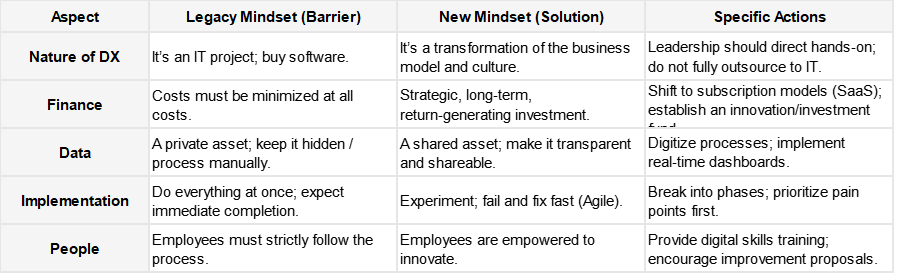
Summary Table: Necessary Mindset Shifts for Vietnamese Businesses
Conclusion
Vietnam’s digital transformation journey is entering a decisive phase. While technology infrastructure and macro‑level policies are already in place, the final and most difficult “bottleneck” to remove still lies in human mindset. Psychological barriers such as the fear of costs, the fear of change, and misaligned expectations are holding back the enormous potential of the SME sector.
However, challenges also represent opportunities. Those enterprises that dare to break old mindsets, accept the necessary “pain” of restructuring, and commit to a long‑term transformation path will become the market leaders of the new era. The lessons from Rạng Đông, PNJ, and Viettel are not lessons about sophisticated technologies, but lessons about the courage of leaders who dare to transform themselves.
To achieve the goal of the digital economy contributing 30% of GDP by 2030, Vietnam needs more than fiber‑optic cables or data centers — it needs a “Mindset Revolution” within every enterprise. Only when business owners view data as valuable as cash flow, and view technology as the lifeblood rather than just clothing, will digital transformation become sustainably successful.
Keywords:
- difficulties in digital transformation in government agencies
- downsides of digital transformation
- digital transformation problems
- advantages and disadvantages of digital transformation
- existing limitations in digital transformation
- what is digital transformation
- difficulties in digital transformation at the commune level
- digital transformation assignment report
- public sector digital transformation barriers a developing country experience
- hybrid framework for investigating digital transformation barriers in the oil and gas sector
- overcoming digital transformation barriers chinese smmes in the sharing economy
- digital transformation barriers for small and medium enterprises in vietnam today
- digital transformation barriers
- the impact of digital transformation in the philippines a study of the key drivers and barriers
- barriers and drivers of digital transformation in smes a conceptual analysis
- barriers to implementation of digital transformation in the indian health sector a systematic review
- rogers five barriers to digital transformation
- barriers to digital transformation in healthcare
Source citations
- Breaking the digital frontier. | UOB, truy cập vào tháng 1 14, 2026, https://www.uob.com.vn/assets/web-resources/business/pdf/en/industry-report/uobv-breaking-the-digital-frontier.pdf
- Digital Transformation in Small and Medium Enterprises (SMEs) in …, truy cập vào tháng 1 14, 2026, https://www.multiresearchjournal.com/admin/uploads/archives/archive-1757669449.pdf
- Tối ưu chi phí chuyển đổi số doanh nghiệp: 5 chiến lược cốt yếu …, truy cập vào tháng 1 14, 2026, https://fsivietnam.com.vn/doanh-nghiep-viet-cat-giam-chi-phi-chuyen-doi-so/
- Mô hình văn hóa doanh nghiệp gia đình và chuyển đổi số, truy cập vào tháng 1 14, 2026, https://hocvienagile.com/mo-hinh-van-hoa-doanh-nghiep-gia-dinh-va-cds/
- Doanh nghiệp e dè chuyển đổi số vì lo mất an toàn dữ liệu, mục tiêu …, truy cập vào tháng 1 14, 2026, https://vnbusiness.vn/cong-nghe/doanh-nghiep-e-de-chuyen-doi-so-vi-lo-mat-an-toan-du-lieu-muc-tieu-kinh-te-so-30-gdp-gap-thach-thuc-1111569.html
- Xu hướng Chuyển đổi số tại Việt Nam và Thế giới năm 2022 | Viindoo – ERPOnline, truy cập vào tháng 1 14, 2026, https://erponline.vn/blog/blog-6/xu-huong-chuyen-doi-so-cua-viet-nam-va-the-gioi-224
- Top 5 case study chuyển đổi số kinh điển mà doanh nghiệp không …, truy cập vào tháng 1 14, 2026, https://irtech.com.vn/top-5-case-study-chuyen-doi-so/
- Doanh nghiệp Việt và chuyển đổi số, bắt đầu từ đâu để tránh thất bại? – Toquoc.vn, truy cập vào tháng 1 14, 2026, https://toquoc.vn/doanh-nghiep-viet-va-chuyen-doi-so-bat-dau-tu-dau-de-tranh-that-bai-82021264945359.htm
- Những lý do chuyển đổi số thường thất bại. 12 nguyên nhân hay gặp – FPT IS, truy cập vào tháng 1 14, 2026, https://fpt-is.com/goc-nhin-so/ly-do-chuyen-doi-so-thuong-that-bai/
- USAID Linkages for Small and Medium Enterprises (LinkSME) – IESC, truy cập vào tháng 1 14, 2026, https://iesc.org/program/linksme/
- Bộ TT&TT chính thức khởi động Chương trình Hỗ trợ doanh nghiệp nhỏ và vừa chuyển đổi số, truy cập vào tháng 1 14, 2026, https://mst.gov.vn/bo-tttt-chinh-thuc-khoi-dong-chuong-trinh-ho-tro-doanh-nghiep-nho-va-vua-chuyen-doi-so-197146308.htm
- Chương trình đào tạo cho mạng lưới chuyên gia tư vấn chuyển đổi số: Nâng tầm chiến lược chuyển đổi số và Công nghiệp 4.0 – Bộ Kế hoạch và Đầu tư, truy cập vào tháng 1 14, 2026, https://www.mpi.gov.vn/portal/Pages/2023/Chuong-trinh-dao-tao-cho-mang-luoi-chuyen-gia-tu-v-251412.aspx
- Chuyển đổi số doanh nghiệp vừa và nhỏ trong kỷ nguyên 4.0 – FPT IS, truy cập vào tháng 1 14, 2026, https://fpt-is.com/goc-nhin-so/chuyen-doi-so-doanh-nghiep-vua-va-nho/
- Evaluating digital transformation preparedness among Vietnamese enterprises – Ho Chi Minh City Open University Journal of Science, truy cập vào tháng 1 14, 2026, https://journalofscience.ou.edu.vn/index.php/econ-en/article/view/3349