
 Tiếng Việt
 Cloud server services
 Business Email
 Content Delivery Network
 Cloud PC
 Linux Security and Hardening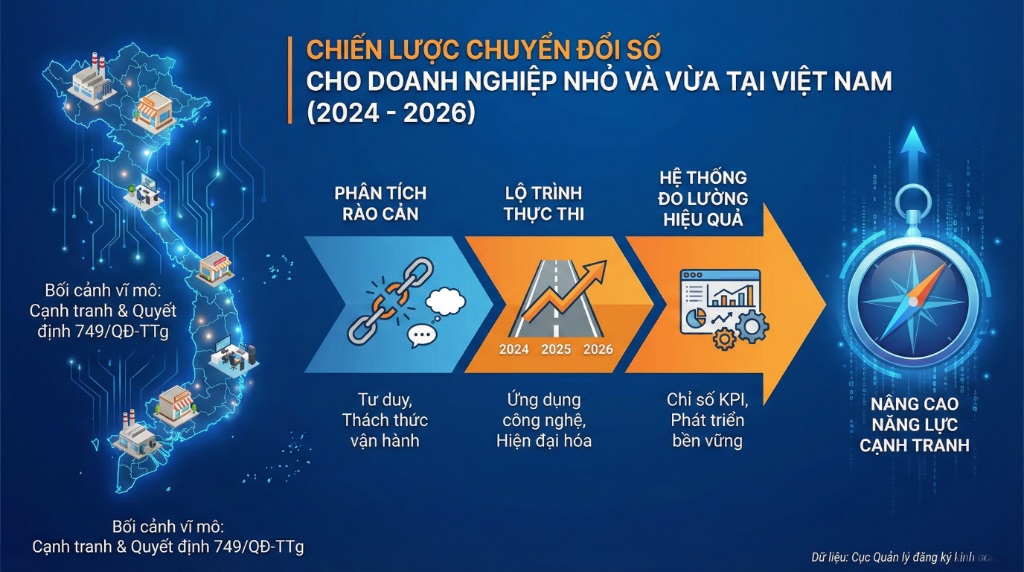
The Vietnamese economy in the 2024–2025 period is undergoing a profound transformation, where the intersection of traditional business models and digital platforms creates unprecedented opportunities and challenges. According to data from the Agency for Business Registration, 2024 saw significant volatility in the enterprise landscape, with an average of over 19,000 new and returning businesses per month.¹ Total market entries and re-entries reached 233,419 units.¹ However, the economic outlook is not without its shadows; market exits climbed to 197,861 units, the majority of which were Small and Medium-sized Enterprises (SMEs) with a capital scale under 10 billion VND and less than five years of operation.¹
This reality highlights a ruthless rule of attrition: businesses lacking agility and lagging in operational modernization will inevitably fall behind. Digital transformation is no longer a luxury or a secondary option; it has become a vital imperative for enhancing competitiveness and ensuring sustainable growth.² Recognizing this trend early, the Vietnamese Government issued Decision No. 749/QD-TTg, approving the “National Digital Transformation Program through 2025, with a vision toward 2030.”⁴ The fact that 22/22 ministries and 63/63 provinces have finalized their Digital Transformation Steering Committees demonstrates a unified political commitment from central to local levels to build a comprehensive digital economy.⁵
Below is a statistical summary of the Vietnamese business landscape in 2024, serving as the foundation for analyzing the urgency of digital transformation:
| 2024 Enterprise Indicator | Volume / Ratio | Implications for Digital Transformation |
|---|---|---|
| Total newly registered and re‑registered enterprises | 233,419 enterprises | Indicates strong market demand for digital‑first solutions from the outset. |
| Enterprises exiting the market | 197,861 enterprises | Highlights weak competitiveness among traditional SMEs and the urgency of digital adoption. |
| Enterprises dissolved with registered capital of VND 0–10 billion | 87.75% (↑ 21.9%) | Micro and small enterprises are the primary target segment requiring digital transformation support. |
| Active digital technology enterprises | ~48,000 enterprises | Demonstrates a rapidly expanding supply ecosystem of digital solutions. |
| Percentage of enterprises interested in digital transformation | 92% | Shows broad-based initial awareness and readiness for digital transformation at scale. |
While interest levels have reached new heights, the actual readiness for Industry 4.0 adoption in production and operations remains limited, specifically in supporting and processing-manufacturing industries.² The gap between ‘interest’ and ‘effective execution’ is largely driven by internal bottlenecks, chief among which is the leadership’s mindset.
Mindset and Perception Barriers: The Strategic Bottleneck for SMEs
Within the digital transformation (DX) journey, technological or financial hurdles are often less formidable than the mindset barrier. For SME owners in Vietnam, this remains the primary obstacle preventing breakthroughs and successful adaptation to the digital era.
Digital Transformation: “Cost” or “Investment”?
One of the most prevalent misconceptions among SMEs is viewing digital transformation as a luxury “cost” rather than a strategic investment.⁶ When viewed through a cost-centric lens, businesses tend to focus on minimizing expenditures, which leads to the adoption of fragmented, non-systemic solutions that lack a long-term roadmap.⁶
Conversely, an investment-oriented mindset requires firms to clearly define future value propositions: increased labor productivity, error minimization, process optimization, and, most crucially, the creation of new value for customers.⁸ Digital transformation consultants play a vital role in shaping this strategy by identifying current operational bottlenecks and recommending technologies that optimize resource allocation.⁸ Furthermore, investing in DX entails essential “hidden” costs—such as data security and cybersecurity—which should account for at least 10% of the total budget to ensure secure operations within the digital ecosystem.¹¹
Fear of Change and Cultural Resistance
Digital transformation typically involves disrupting established traditional workflows and Legacy Systems that have been in place for years.⁶ Hesitation toward novelty, the fear of shifting work habits, and the workforce’s perceived inability to adapt create significant psychological barriers. For medium and large-scale enterprises, complex organizational structures make shifting corporate culture a more taxing challenge than it is for micro-enterprises.⁶
At its core, digital transformation is not merely the deployment of new technology; it is a comprehensive Business Process Reengineering (BPR) effort that reshapes operational methods and the mindset of the entire workforce.⁹ This resistance can only be neutralized through unwavering commitment from C-suite leadership and an effective internal communication strategy.⁹
The Trap of Immediate ROI Expectations
Another common barrier is the expectation of an immediate Return on Investment (ROI), whereas digital transformation is inherently a long-term strategic evolution.¹³ The failure to see a sharp spike in net profit immediately following an ERP or CRM implementation often leads to frustration and the premature abandonment of projects.⁶
Businesses must recognize that initial benefits are frequently qualitative—such as improved operational efficiency and employee engagement—before they translate into quantitative financial metrics.¹³ Establishing short, medium, and long-term milestones is essential to maintaining organizational momentum throughout the transformation lifecycle.¹⁴
Analysis of Differences in Digital Transformation Mindset
Legacy Mindset (Viewing Digital Transformation as a Cost)
- Focuses primarily on immediate upfront expenditure rather than long-term value creation.
- Perceives technology mainly as a replacement for human labor, not as an enabler of productivity or innovation.
- Implements isolated, point solutions to address individual issues rather than adopting an integrated approach.
- Avoids risk and is concerned about disrupting existing processes and operational stability.
- Expects immediate financial returns following system implementation.
Governmental Policy Frameworks and Support Programs
Recognizing the inherent challenges faced by SMEs, the Vietnamese Government—primarily through the Ministry of Planning and Investment (MPI) in collaboration with international organizations—has launched several practical support initiatives to accelerate the digital transition.
The National SME Digital Transformation Support Program (2021–2025)
Operating under Decision No. 12/QD-BKHĐT, this flagship program is spearheaded by the MPI and supported by USAID (via the LinkSME Project).¹⁶ The program’s targets for 2025 are highly ambitious:
Awareness Elevation: 100% of enterprises to be reached through digital awareness and literacy campaigns.¹⁶
Scale of Support: At least 100,000 enterprises to receive support, including access to digital readiness assessment tools, training, and solution matching.¹⁶
Success Benchmarks: At least 100 enterprises to be developed into “Success Stories” (lighthouse projects), particularly within the manufacturing and processing sectors.¹⁶
Expert Network: Establishment of a network comprising at least 100 specialized consulting organizations and individuals.¹⁶
The program provides tiered solution packages tailored to an enterprise’s maturity level:
Start Digital: For businesses initiating the digitization of basic processes.¹⁶
Grow Digital: For expanding businesses requiring technological optimization.¹⁶
Go Digital – Go Global: Supporting enterprises in scaling to international markets via cross-border e-commerce platforms.¹⁷
Ho Chi Minh City Initiatives and the Role of HUBA
Ho Chi Minh City (HCMC) currently leads the nation in the Digital Transformation Index (DTI), specifically in digital awareness and institutional frameworks.¹⁹ The digital economy contributed 22% to the city’s GRDP in 2024, with a target of 25% by 2025.²⁰
The HCMC Union of Business Associations (HUBA) and the HCMC Computer Association (HCA) have partnered with Viettel Group to provide free digital transformation support to 2,000 SMEs through 2025.²¹ Participants receive one year of free access to the Viettel-CODX Digital Office platform, enabling data digitization and workflow automation.²¹ This shift is estimated to reduce operational costs by up to 11%.²¹
For the 2025–2030 term, HUBA is prioritizing the “Dual Transition”: the intersection of Digital Transformation and Green Transformation.²³ Specialized seminars such as “Smart Factory 2025: AI for Green Factory” focus on integrating Artificial Intelligence into sustainable manufacturing, helping businesses navigate increasingly stringent ESG (Environmental, Social, and Governance) requirements.²³
Digital Transformation Roadmap and Methodology for SMEs
To overcome mindset barriers and ensure effective execution, enterprises should adopt proven scientific models and a structured roadmap.
The Three Stages of Digital Evolution
Digital transformation is not a single leap but a continuous evolution consisting of three primary stages:⁹
Digitization: Converting analog information (paper-based) into digital formats (electronic files). This is the foundational step for centralized data management.⁹
Digitalization: Leveraging technology to automate existing workflows without fundamentally changing the business model (e.g., implementing ERP, iOffice document management, or digital signatures).⁹
Digital Transformation: A total strategic pivot where the business and operational models are restructured around a digital data foundation to create new value for customers.⁹
Applying the ADKAR Change Management Model
To address psychological and cultural resistance, the ADKAR model (developed by Jeff Hiatt) is an effective individual-centric tool for managing change.²⁶ The ADKAR journey involves five steps:²⁶
Awareness: Employees must understand why the transformation is necessary. Leadership must communicate current pain points and how technology solves them, rather than simply issuing top-down mandates.²⁶
Desire: Fostering the motivation to participate in and support the change by highlighting personal benefits (e.g., workload reduction, streamlined tasks).²⁶
Knowledge: Providing specific training on how to use new tools and navigate new processes via workshops, videos, or interactive guides.²⁶
Ability: Ensuring employees can practically execute new skills. SMEs should implement changes in phases to allow staff time to adapt and build confidence.²⁶
Reinforcement: Sustaining the change through recognition, rewards for early adopters, and continuous evaluation to prevent a regression to old habits.²⁶
The 7-Step Holistic Digital Transformation Process
Based on consulting best practices from firms like FPT Digital, SMEs can follow this 7-step framework:²⁴
Define Objectives: Determine the core “Why” (e.g., Boosting productivity? Enhancing CX?).⁹
Current State Assessment: Analyze existing human capital, processes, technology, and data.⁹
Strategy Formulation: Develop a plan tailored to current capabilities, prioritizing high-value, low-risk digital initiatives.⁹
Implementation Planning: Detail the budget, resources, and timelines for each milestone.⁹
Infrastructure & Data Foundation: Select appropriate solutions (Cloud, AI, IoT) ensuring system interoperability.¹⁰
Human Capital Readiness: Train the workforce and foster an innovation-ready culture.²⁴
Full-scale Execution & Digitalization: Step-by-step implementation from info-digitization to business model transformation.⁹
Financial Management and Performance Measurement (ROI & KPI)
The inability to quantify results is the primary reason SME owners view DX as an expense. A robust measurement system proves the project’s tangible value.
Calculating Return on Investment (ROI)
ROI is the critical metric for evaluating the efficiency of a technology investment.¹³ Experts suggest a 5-step approach to ROI calculation:¹⁴
Step 1: Define specific objectives and align them with ROI targets.
Step 2: Analyze the current operational cost baseline.
Step 3: Use a diverse set of metrics (including time savings and error reduction, not just cash).
Step 4: Establish measurement milestones (Short-term for momentum; Long-term for net profit).
Step 5: Continuously monitor and iterate the strategy.
Primary costs include technology acquisition, process reengineering, personnel training, and—crucially—data security expenditures.⁶
Digital Transformation Key Performance Indicators (KPIs)
Enterprises should develop SMART (Specific, Measurable, Achievable, Relevant, Time-bound) KPIs.³¹ Typical KPI groups include:
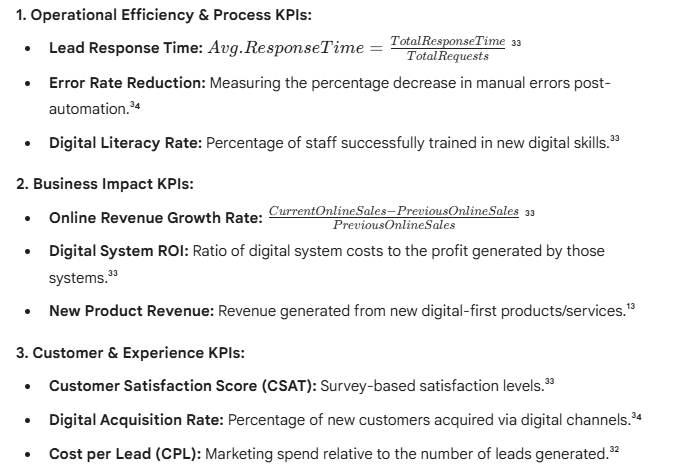
Summary of Key KPI Formulas for SMEs
Online Sales Growth Rate: Measures the percentage increase in revenue generated specifically through digital channels over a defined period.
Customer Satisfaction Score (CSAT): A standard metric derived from customer surveys to gauge the quality of the digital experience.
Digital Skills Training Rate: Tracks the percentage of the workforce that has successfully completed upskilling or reskilling programs focused on digital tools.
Return on Investment (ROI): A critical financial metric used to evaluate the efficiency and profitability of digital transformation expenditures.
Solution Ecosystems and Success Stories
Selecting technology that aligns with an organization’s scale and sector-specific requirements is a decisive factor in the success of digital transformation (DX). For Vietnamese SMEs, Cloud-native solutions and Software-as-a-Service (SaaS) are typically preferred due to their flexible cost structures and minimal hardware infrastructure requirements.
Prominent Solution Providers in Vietnam
The technological ecosystem in Vietnam has matured significantly, offering comprehensive suites for SMEs ¹⁷:
Enterprise Resource Planning (ERP) & Finance: MISA AMIS (unified platform), VNPT ASME (SME-specific accounting), Cloudify Books.¹⁷
Document Management & Operations: VNPT-iOffice (digital operations), SmartDOCS (document archiving).¹⁷
Human Capital Management (HCM) & Workflow: Base.vn (Wework, Request, Workflow), Cloudify HRM.¹⁷
Digitization & E-Signatures: SmartOCR (Optical Character Recognition), VNPT CA & SmartCA (Remote digital signing).¹⁷
Public Digital Services: VNPT BHXH (Social insurance declarations), VNPT Invoice (E-invoicing).¹⁷
Lessons Learned from Success Stories
While these examples often feature global corporations, the core principles are highly applicable to the SME context:
Starbucks: Achieved success through its “Digital Flywheel” strategy, utilizing AI to personalize customer experiences and optimize inventory management.³⁵ Lesson for SMEs: Customer data is your most valuable asset; leverage it to drive hyper-personalization.³⁵
Netflix: Courageously pivoted from a traditional DVD rental model to a data-driven streaming platform—a classic case of Business Model Innovation.³⁵ Lesson for SMEs: Do not remain tethered to traditional models; be ready to pivot as market dynamics shift.³⁵
Nike: Utilized foot-scanning apps to provide product recommendations and gather R&D data.³⁵ Lesson for SMEs: Deploy technology to solve specific customer “pain points.”
In the local context, enterprises such as Viettel, EVN, and TPBank serve as benchmarks for leveraging technology to break through productivity ceilings and optimize operations.³⁶ For an SME, success can begin with automating office functions, which has been shown to optimize 77% of activities and reduce costs by 11%.²²
Conclusion and Strategic Recommendations
Digital transformation is not a destination but a continuous journey toward value creation. To navigate mindset barriers and ensure successful execution through 2026, SMEs should prioritize the following strategic recommendations:
Shift from “Cost” to “Investment”: Leadership must view DX as a strategic investment. This commitment must be evidenced by active project sponsorship, appropriate budget allocation (including cybersecurity contingencies), and a commitment to the long-term roadmap.⁹
Prioritize People and Culture: Technology is merely an enabler; success is determined by the people using it. Adopt structured Change Management models (such as ADKAR) to ensure employees understand, desire, and are capable of implementing change.²⁶
Pursue “Short-Term Wins”: SMEs should avoid “boiling the ocean” with total transformation at the outset. Start by digitizing the most critical bottlenecks or departments that deliver immediate customer value to build organizational momentum.¹⁵
Leverage the Support Ecosystem: Maximize the resources offered by the Government and industry associations. Engaging with Ministry of Planning and Investment programs or HUBA/Viettel support packages reduces financial pressure and provides access to professional consultancy.¹⁶
Maintain Continuous Measurement: Implementing a robust KPI and ROI framework is mandatory for tracking progress. Data transparency empowers leadership to make agile strategic adjustments, ensuring the enterprise remains on course in a volatile digital landscape.¹⁴
References
- Báo cáo tình hình đăng ký doanh nghiệp năm 2024, truy cập vào tháng 2 7, 2026, https://dangkykinhdoanh.gov.vn/vn/tin-tuc/599/6818/bao-cao-tinh-hinh-dang-ky-doanh-nghiep-nam-2024.aspx
- Chuyển đổi số doanh nghiệp tại Việt Nam: Thuận lợi và thách thức, truy cập vào tháng 2 7, 2026, https://mst.gov.vn/chuyen-doi-so-doanh-nghiep-tai-viet-nam-thuan-loi-va-thach-thuc-19724123111542568.htm
- Hỗ trợ doanh nghiệp nhỏ và vừa chuyển đổi số: Kinh nghiệm quốc tế và vận dụng cho Việt Nam, truy cập vào tháng 2 7, 2026, https://tapchicongthuong.vn/ho-tro-doanh-nghiep-nho-va-vua-chuyen-doi-so–kinh-nghiem-quoc-te-va-van-dung-cho-viet-nam-265792.htm
- Quyết định số 749/QĐ-TTg của Thủ tướng Chính phủ: Phê duyệt “Chương trình Chuyển đổi số quốc gia đến năm 2025, định hướng đến năm 2030”, truy cập vào tháng 2 7, 2026, https://chinhphu.vn/default.aspx?pageid=27160&docid=200163
- BÁO CÁO Chuyển đổi số quốc gia tháng 6 năm 2024 Thực hiện các, truy cập vào tháng 2 7, 2026, https://mic.mediacdn.vn/639352410187198464/2024/7/4/bao-cao-tinh-hinh-chuyen-doi-so-quoc-gia-thang-6-nam-2024-17200556793161687917770.pdf
- Rào cản, khó khăn của doanh nghiệp khi chuyển đổi số, truy cập vào tháng 2 7, 2026, https://dangkykinhdoanh.gov.vn/vn/tin-tuc/611/5730/rao-can–kho-khan-cua-doanh-nghiep-khi-chuyen-doi-so-.aspx
- Chuyển đổi số trong doanh nghiệp nhỏ và vừa: Thách thức và giải pháp, truy cập vào tháng 2 7, 2026, https://dx.moj.gov.vn/chuyen-doi-so-trong-doanh-nghiep-nho-va-vua-thach-thuc-va-giai-phap-929.htm
- Tầm quan trọng của chuyên gia chuyển đổi số trong môi trường kinh doanh hiện đại, truy cập vào tháng 2 7, 2026, https://izisolution.vn/tam-quan-trong-cua-chuyen-gia-chuyen-doi-so-trong-moi-truong-kinh-doanh-hien-dai/
- Chuyển đổi số là gì? Cẩm nang cho doanh nghiệp thời 4.0 – FPT IS, truy cập vào tháng 2 7, 2026, https://fpt-is.com/goc-nhin-so/chuyen-doi-so/
- Chuyển đổi số doanh nghiệp vừa và nhỏ SME – FastWork, truy cập vào tháng 2 7, 2026, https://fastwork.vn/chuyen-doi-so-doanh-nghiep-vua-va-nho/
- Đầu tư bao nhiêu để doanh nghiệp chuyển đổi số thành công? – Vũ Thảo, truy cập vào tháng 2 7, 2026, https://www.vuthao.com.vn/dau-tu-bao-nhieu-de-doanh-nghiep-chuyen-doi-so-thanh-cong-243.html
- Quản trị sự thay đổi: Mô hình, nguyên tắc, quy trình triển khai, truy cập vào tháng 2 7, 2026, https://www.pace.edu.vn/tin-kho-tri-thuc/quan-tri-su-thay-doi-la-gi
- 10 chỉ số đo lường hiệu quả chuyển đổi số của doanh nghiệp 2024, truy cập vào tháng 2 7, 2026, https://blog.slimcrm.vn/chuyen-doi-so/10-chi-so-do-luong-hieu-qua-chuyen-doi-so-cua-doanh-nghiep-2023
- Tính ROI tại Webinar Tính toán hiệu quả đầu tư chuyển đổi số | iERP, truy cập vào tháng 2 7, 2026, https://ierp.vn/tim-kiem-giai-phap-tinh-roi-tai-hoi-thao-truc-tuyen-tinh-toan-hieu-qua-dau-tu-cho-chuyen-doi-so/
- 5 giai đoạn của Lộ trình chuyển đổi số & các bước thực hiện – Fastwork, truy cập vào tháng 2 7, 2026, https://fastwork.vn/lo-trinh-chuyen-doi-so/
- Giới thiệu – Chương trình hỗ trợ doanh nghiệp chuyển đổi số, truy cập vào tháng 2 7, 2026, https://digital.business.gov.vn/gioi-thieu/
- Đánh giá 1 – Chương trình hỗ trợ doanh nghiệp chuyển đổi số, truy cập vào tháng 2 7, 2026, https://digital.business.gov.vn/danh-gia-1/
- 3 rào cản doanh nghiệp đối mặt khi chuyển đổi số, truy cập vào tháng 2 7, 2026, https://chuyendoiso.hochiminhcity.gov.vn/en/-/3-rao-can-doanh-nghiep-oi-mat-khi-chuyen-oi-so
- TP.HCM giữ vững vị thế dẫn đầu cả nước về Chỉ số Chuyển đổi số, truy cập vào tháng 2 7, 2026, https://dost.hochiminhcity.gov.vn/chuyen-doi-so/tphcm-giu-vung-vi-the-dan-dau-ca-nuoc-ve-chi-so-chuyen-doi-so/
- TPHCM trong nhóm dẫn đầu cả nước về chuyển đổi số, truy cập vào tháng 2 7, 2026, https://ttbc-hcm.gov.vn/tphcm-trong-nhom-dan-dau-ca-nuoc-ve-chuyen-doi-so-1019820.html
- TP.HCM: 2.000 doanh nghiệp SME được hỗ trợ miễn phí chuyển đổi số, truy cập vào tháng 2 7, 2026, https://nongthonviet.com.vn/tphcm-2000-doanh-nghiep-sme-duoc-ho-tro-mien-phi-chuyen-doi-so.ngn
- 2.000 doanh nghiệp SME tại TP.HCM được hỗ trợ chuyển đổi số – VnEconomy, truy cập vào tháng 2 7, 2026, https://vneconomy.vn/2-000-doanh-nghiep-sme-tai-tp-hcm-duoc-ho-tro-chuyen-doi-so.htm
- Ra Mắt Hội Doanh Nghiệp Khu Vực Tây Sài Gòn Nhiệm Kỳ 2025 …, truy cập vào tháng 2 7, 2026, https://huba.vn/hoi-doanh-nghiep-khu-vuc-tay-sai-gon-nhiem-ky-2025-2030/
- Quy trình chuyển đổi số: 7 hạng mục công việc giúp chuyển đối số thành công – FPT Digital, truy cập vào tháng 2 7, 2026, https://digital.fpt.com/tu-van/quy-trinh-chuyen-doi-so.html
- Tối ưu giải pháp chuyển đổi số cho doanh nghiệp vừa và nhỏ – oneSME, truy cập vào tháng 2 7, 2026, https://onesme.vn/blog/tin-tuc-su-kien/chuyen-doi-so-cho-doanh-nghiep-vua-va-nho.html
- Mô hình ADKAR là gì? Cách áp dụng để quản lý sự thay đổi – Công …, truy cập vào tháng 2 7, 2026, https://ocd.vn/mo-hinh-adkar/
- Mô hình ADKAR là gì? Ứng dụng và ví dụ thực tế trong quản trị thay đổi – SOM AIT, truy cập vào tháng 2 7, 2026, https://som.edu.vn/mo-hinh-adkar-la-gi/
- 10 mô hình quản lý sự thay đổi | Tư vấn quản trị doanh nghiệp – Trí Phúc, truy cập vào tháng 2 7, 2026, https://www.triphuc.com/10-mo-hinh-quan-ly-su-thay-doi.html
- 5 bước đơn giản để áp dụng Mô hình ADKAR vào thay đổi tổ chức – Đàm Thế Ngọc, truy cập vào tháng 2 7, 2026, https://damthengoc.vn/5-buoc-don-gian-de-ap-dung-mo-hinh-adkar-vao-thay-doi-to-chuc/
- Quy trình 7 bước chuyển đổi số doanh nghiệp – Viện Quản trị số – IDA, truy cập vào tháng 2 7, 2026, https://vienqts.com/chuyen-doi-so-cho-doanh-nghiep-quy-trinh-7-buoc/
- KPI là gì? Hướng dẫn xây dựng KPI hiệu quả cho doanh nghiệp Việt – CloudGO, truy cập vào tháng 2 7, 2026, https://cloudgo.vn/kpi-la-gi
- 15 chỉ số KPIs quan trọng quyết định hiệu quả chiến dịch Marketing – MISA AMIS, truy cập vào tháng 2 7, 2026, https://amis.misa.vn/23244/marketing-kpi/
- 10 chỉ số KPI phải biết giúp doanh nghiệp đo lường hiệu quả chuyển đổi số – Công ty FSI, truy cập vào tháng 2 7, 2026, https://fsivietnam.com.vn/10-chi-so-kpi-do-luong-chuyen-doi-so/
- Chỉ số KPI đánh giá hiệu quả dự án chuyển đổi số, truy cập vào tháng 2 7, 2026, https://ocd.vn/chi-so-kpi-danh-gia-hieu-qua-du-an-chuyen-doi-so/
- 11 ví dụ về chuyển đối số thành công trong các doanh nghiệp – Base, truy cập vào tháng 2 7, 2026, https://base.vn/blog/vi-du-ve-chuyen-doi-so/
- 11 doanh nghiệp chuyển đổi số thành công – Geneat Software, truy cập vào tháng 2 7, 2026, https://geneat.vn/11-doanh-nghiep-chuyen-doi-so-thanh-cong/